Fashion & Lifestyle
1,154 leads from 4,338 game sessions for FILA
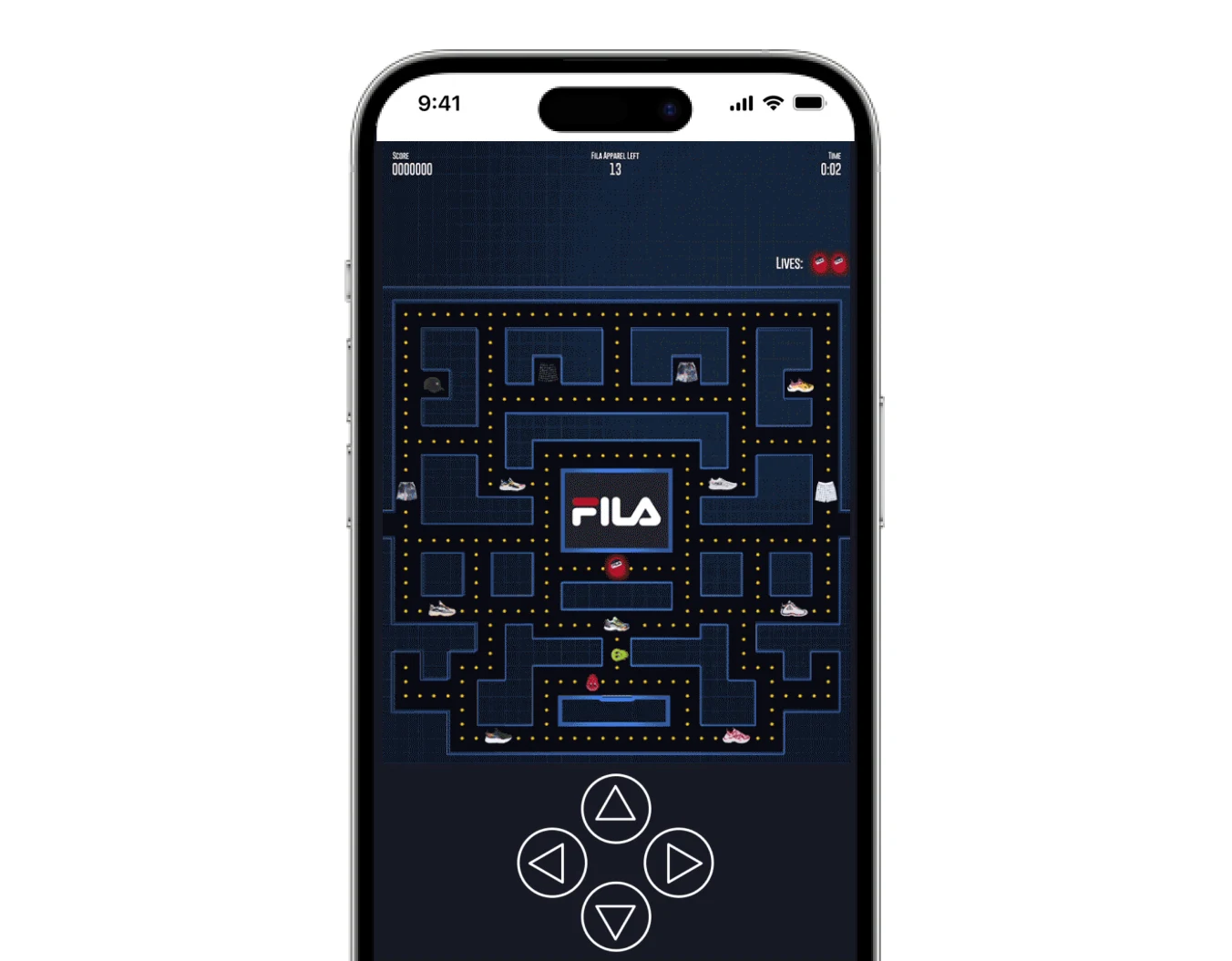
FILA wanted to combine brand engagement and newsletter growth through a playful mechanic — with no app requirement and no hardware logistics. UpReach built a browser-based smartphone game in a Pac-Man-inspired style: players moved through a maze, collected FILA branded items and avoided enemies. High scores earned places on the leaderboard and chances to win. The result: 4,338 sessions played, 1,154 GDPR-compliant newsletter leads, 1.7 seconds of average interaction time per move.

More than 200 B2B brands from across Europe trust UpReach — from agencies to enterprise corporations.





The initial situation
Brand engagement in the sport and lifestyle segment is fiercely contested. Classic display ads see falling click-through rates, newsletter recruiting via static forms has high drop-off rates, and event activations only reach the audience physically present.
The activation called for a digital mechanism that scales across regions while creating enough interaction depth to make the FILA brand more than just visually present. Three hard constraints defined the brief: no app download (any installation requirement would have halved the entry rate), GDPR-compliant lead capture with documented opt-in, and a game mechanic that integrates FILA branded items into the content itself — not a generic game with a logo sticker.
An additional requirement: the play time per session had to be long enough to create brand contact, but short enough to keep the willingness to replay high. Classic casual-game mechanics (match-three, endless runner) would not have anchored the brand in the content.


The UpReach solution
UpReach built a browser-based smartphone game with Pac-Man-inspired mechanics. Players moved through a maze, had to avoid enemies and collect FILA branded items as points. The brand integration was built into the game mechanic itself — the branded items were the actual objective of the game, not just a decorative element.
The leaderboard mechanic created active return motivation: players came back repeatedly to improve their score and climb to the top ranks. The top placements brought concrete chances to win — the winners were notified after the campaign and received FILA products as prizes.
Before starting, every participant went through the GDPR-compliant data gate: name, email address, newsletter opt-in with timestamp. The prize notifications at the end of the campaign were also used as a cross-selling vehicle: they promoted new FILA styles and led participants back into the FILA shop — a link between gamification engagement and direct sales support.
The campaign was promoted across several channels (social-media ads, newsletter cross-promotion, FILA website banners) to drive players into the game.


Setup & Logistics
Lead time six weeks: four weeks for software development (Pac-Man-inspired game logic, maze design in the FILA brand look, item integration with FILA products, leaderboard backend, GDPR opt-in screen), one week for campaign asset production (social-media creatives, newsletter templates, website banners), one week for cross-channel testing and legal sign-off of the terms of participation.
During the campaign run, weekly monitoring tracked session volume, conversion rate from game start to opt-in and leaderboard activity. The cloud CMS allowed adjustments to the game mechanic (difficulty, item distribution) during live operation, with no new code-deployment effort.
After the campaign, the winner determination ran via the leaderboard, with automated prize-notification emails to the top performers and the cross-selling pipeline linking to new FILA styles.
Results by the numbers
game sessions
GDPR-compliant newsletter leads
seconds average interaction time per move
The conversion rate from session to GDPR-compliant lead was around 27% — a far higher figure than classic newsletter-recruiting forms without a playful mechanic (typically below 5%). The lever was the link between opt-in and chance to win: anyone who took part in the game had a visible return for sharing their data.
The 1.7 seconds of average interaction time per move shows a tight feedback loop — typical of casual-game mechanics with a high willingness to replay. Players were actively engaged throughout the play time, not passively watching.
The cross-selling pipeline at the end of the campaign delivered additional sales-funnel data: how many of the winning participants clicked through to the FILA shop, and which styles were in particular demand afterwards — a data layer that pure display campaigns cannot access.
Key takeaways from this setup
Branded items as the objective beat a logo sticker: when the brand is only a decorative element, it gets overlooked. When the branded items are the actual objective, the brand is tied to positive actions (collecting, scoring) within the content.
A leaderboard creates return motivation: classic single-use game mechanics are done after one session. A leaderboard with concrete chances to win creates return frequency — players come back to improve their position.
The prize notification is a cross-selling trigger: the email to the top performers at the end of the campaign is more than just a win confirmation — it is a highly relevant marketing touchpoint with above-average open and click rates. Cross-selling new styles in that email extends the conversion funnel beyond the gamification itself.
UpReach Components Used
Hardware
No client hardware — bring your own device (smartphone)
Software 01
Gamification backend with dynamic difficulty control
Software 02
Browser-based Pac-Man-inspired game engine, GDPR opt-in screen, leaderboard backend, automated prize notification with cross-selling templates, cloud CMS
Browser-based gamification for your sport or lifestyle brand
UpReach builds smartphone games with brand integration, a leaderboard and GDPR opt-in — with no app requirement and a cross-selling pipeline at the end of the campaign.