1,154 qualified leads from 4,338 sessions for Microsoft at B2B trade fairs
Microsoft deployed the UpReach Classic photo booth across several B2B trade fairs and generated 4,338 sessions and 1,154 qualified CRM leads — a conversion rate of 26.6 percent. At 1.7 sessions per user, many visitors returned to the activation more than once. The mechanism: Microsoft brand worlds as AI backgrounds, an incentive pipeline (newsletter, discount, earlier beta access) and an UpReach KPI dashboard that gave Microsoft marketing teams live campaign performance for active control.

More than 200 B2B brands from across Europe trust UpReach — from agencies to enterprise corporations.





The initial situation
At B2B trade fairs Microsoft needs two things at once: brand presence at high-exposure touchpoints and qualified lead records that move straight into the Microsoft marketing ecosystem. Standard lead-capture stations (a tablet with a form, a business-card box) generate neither stand pull nor genuinely qualified records — they only collect what would have passed the stand anyway.
The strategic question: which mechanism creates a magnet that motivates stand visitors to hand over their data voluntarily? Standard questionnaires do not work — the visitor has to see a clear return.
The second aspect: Microsoft's internal marketing teams needed to track performance in real time — not only post-event via a CSV export. Live visibility of session volume, conversion rate and incentive distribution was a hard requirement for actively steering multi-fair campaigns.


The UpReach solution
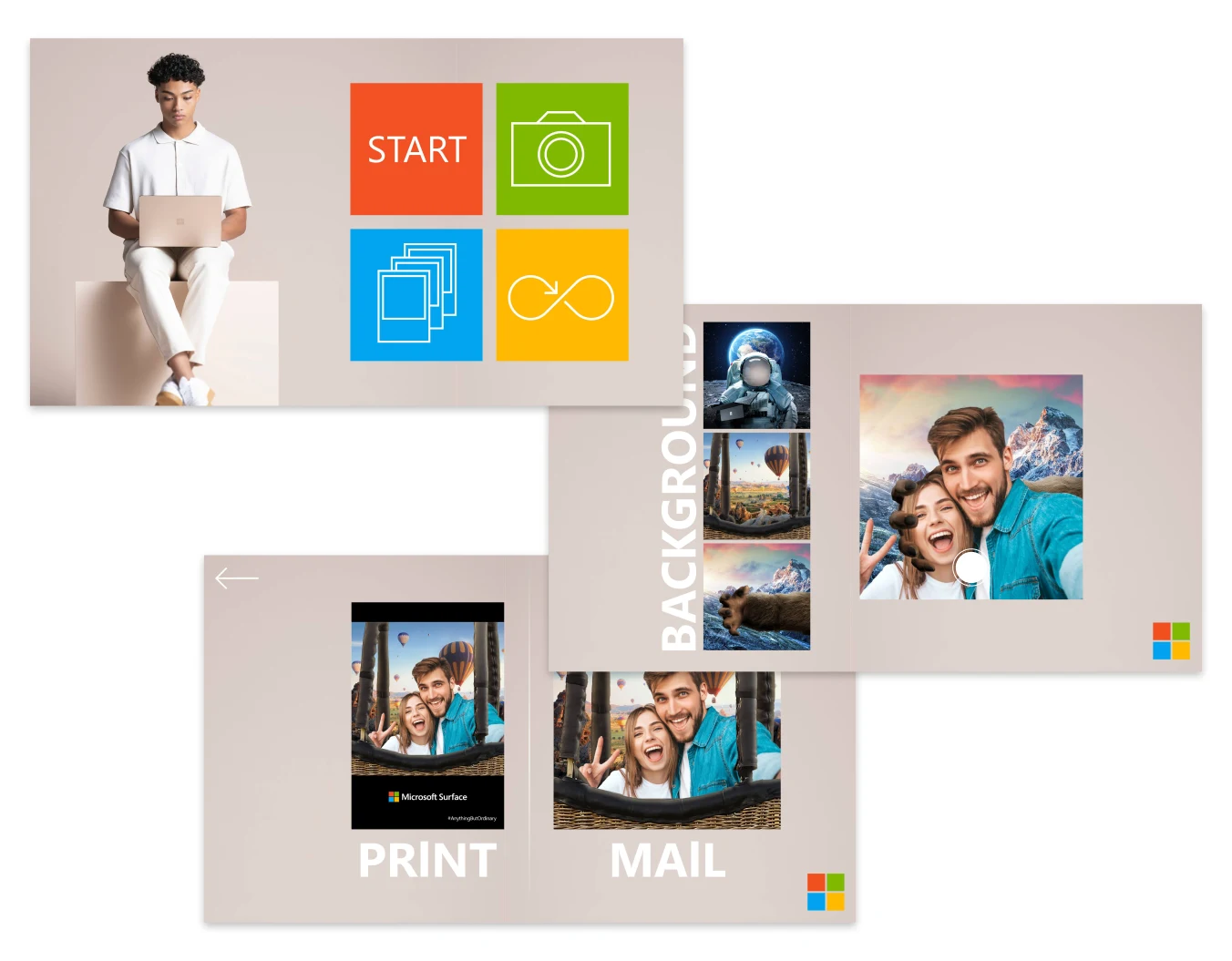
UpReach supplied the Classic photo booth in a Microsoft brand design. The software interface was tailored to the respective Microsoft product message of each fair — screens, brand worlds as AI backgrounds, Microsoft branding across the entire user flow. Visitors could have their photo taken in front of various Microsoft-related brand worlds and "step into" the respective Microsoft product universes in personalised images.
The conversion lever was the multi-stage incentive pipeline. Step 1: photo capture with AI background removal. Step 2: GDPR-compliant data request form with explicit opt-in. Step 3: incentive choice — newsletter sign-up, discount code or earlier beta access to new products. Step 4: image delivery digitally or as a physical print.
The choice of incentive was decisive: rather than a single standard reward, the visitor could decide what was relevant to them. This measurably increased opt-in willingness.
The second lever was the UpReach KPI dashboard. Microsoft marketing teams had real-time visibility of sessions per fair, conversion rate, incentive distribution and daily footfall — enabling active campaign control during the live fair rather than after-the-fact analysis. More on the software: /software.


Setup & Logistics
Lead time of around 4 weeks per fair: 2 weeks of software configuration in the respective Microsoft product CI, 1 week of incentive-pipeline setup (newsletter connection, discount-code generator, beta-access linking), 1 week of GDPR approval and final end-to-end testing of the lead pipeline.
Build and calibration per fair by an UpReach technician, with daily on-site review of the performance trend. The UpReach hardware configuration stayed identical across the fairs, while the software configuration was adapted per fair to the respective Microsoft campaign — so the multi-fair scale ran on a stable hardware setup with a variable software layer.
Data pipeline during the fair: every confirmed consent was transferred to the cloud CMS with a timestamp and the incentive choice. Newsletter opt-ins, discount-code delivery and beta-access links were triggered automatically depending on the visitor's choice. After each fair, the complete lead record was handed over in structured form to the Microsoft CRM and marketing teams.
Results by the numbers
multi-fair sessions
qualified leads
sessions per user
4,338 sessions spread across several B2B trade fairs show how well the setup scales across repeated multi-fair use. The 26.6 percent conversion from session to qualified lead sits well above typical trade-fair lead rates — the central mechanism is the choice of incentive.
The 1.7 sessions per user is a notable figure. It means visitors come back voluntarily, or activate several photo sessions within the same stand visit. That is a strong indicator of genuine brand engagement and enjoyment of the setup — not just a quick selfie.
All 1,154 leads were captured via GDPR-compliant opt-ins, with a timestamp, the chosen incentive (newsletter, discount or beta access) and a source tag (fair name) as metadata. The entire lead block was therefore ready to process directly in the Microsoft CRM — segmentable by incentive preference, with no legal rework.
Key takeaways from this setup
Choice beats a standard incentive: when visitors can choose between newsletter, discount code and beta access, opt-in willingness rises measurably. Standard incentives (newsletter only, discount only) do not reach the same conversion rate — the act of choosing itself raises the visitor's commitment to handing over data.
A live KPI dashboard is campaign control, not post-event reporting: Microsoft marketing teams could see during the live fair which incentives pulled hardest and which fairs underperformed. That enabled active adjustments on later days — from stand-staff briefing to stand positioning.
1.7 sessions/user is proof of stand magnetism: a re-activation rate above 1.5 is a reliable indicator that the activation genuinely creates pull — not merely collecting stand traffic, but prompting active repeat use.
UpReach Components Used
Hardware
UpReach Classic photo booth with Microsoft wrap, print hardware
Software 01
AI background removal with curated Microsoft product worlds
Software 02
White-label UI in the Microsoft product CI, GDPR data gate, multi-stage incentive-choice pipeline (newsletter, discount code, beta access), live KPI dashboard in the cloud CMS
Multi-fair lead pipeline with a real-time KPI dashboard
UpReach builds lead-generation setups for repeated multi-fair use — with incentive-choice mechanics, a GDPR-compliant pipeline and a live dashboard for internal campaign control.